National Council for the Social Studies

About NCSS

Expectations of Excellence: Curriculum Standards for Social Studies

Buy the book
Our 2006 Publications Catalog lists dozens of volumes that help you in your classroom and your profession. From standards to lessons to research, it's one stop shopping for the social studies professional! (Excerpts from the printed book of social sutdies curriculum standards appear below.)
Download our catalog in PDF format


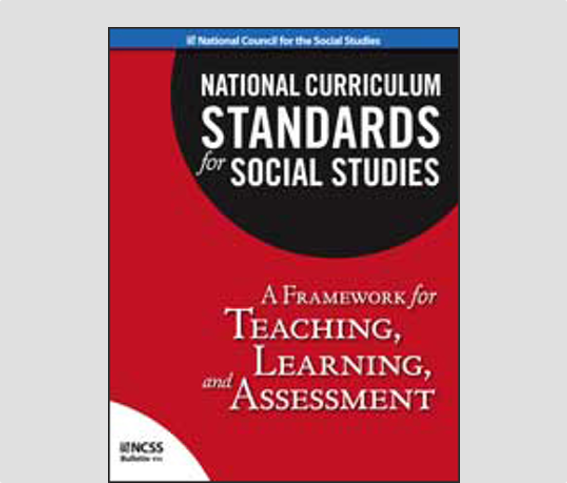
Image of the Standards book

The Curriculum Standards for Social Studies were developed by a Task Force of the National Council for the Social Studies and approved by the NCSS Board of Directors in April 1994.

Task Force:
Donald Schneider, Chair
Susan A. Adler
R. Beery
Gloria Ladson-Billings
William R. Fernekes
Michael Hartoonian
Mary A. McFarland
Gerald Marker
Marjorie A. Montgomery
Pat Nickell
Corrinne Tevis

National Council for the Social Studies
President, 1991-92: Margit McGuire
President, 1992-93: Charlotte C. Anderson
President, 1993-94: Denny Schillings
President, 1994-95: Robert J. Stahl

Executive Director: Susan Griffin
Director of Publications: Michael Simpson
Art Director: Gene Cowan

Editorial services for this publication and writing of the executive summary provided by Lynn Page Whittaker of Scorpio Educational Communications, Alexandria, VA.

Library of Congress Catalog Card Number: 94-068635

Copyright © 1994 National Council for the Social Studies
8555 Sixteenth Street
Silver Spring, Maryland 20910
All rights reserved.

ISBN 0-87986-065-0

All rights reserved. No part of this publication may be reproduced, stored in a retrieval system, or transmitted, in any form or by any means, electronic, mechanical, photocopying, recording, or otherwise, without the prior written permission of the copyright owner.

Electronic Publication on NCSS Online: January, 1996.
Copyright © 1994 National Council for the Social Studies. All electronic rights reserved.


Table of Contents

Executive Summary

Foreword: Robert J. Stahl

Preface: Michael Hartoonian

I. Introduction

  • What Is Social Studies?
  • How Do We Achieve Excellence in Social Studies?
    1. Supporting the Common Good
    2. Adopting Common and Multiple Perspectives
    3. Applying Knowledge, Skills, and Values to Civic Action
  • How Do We Meet the Social Studies Standards?
    1. Needed: Public Commitment, Time, and Resources
    2. Principles of Teaching and Learning
    3. School as a Learning Place
  • What Is the Purpose of the Social Studies Standards?
  • How Are the Social Studies Standards Organized?
  • Who Can Use the Social Studies Standards and How?
  • What Is the Relationship of the Social Studies Standards to Other Standards in the Field?

II. Ten Thematic Strands in Social Studies

  • Culture
  • Time, Continuity, and Change
  • People, Places, and Environment
  • Individual Development and Identity
  • Individuals, Groups, and Institutions
  • Power, Authority, and Governance
  • Production, Distribution, and Consumption
  • Science, Technology, and Society
  • Global Connections
  • Civic Ideals and Practices

III. Standards and Performance Expectations for Early Grades, Middle Grades, and High School: Reference Charts

IV. Standards into Practice: Examples for the Early Grades

V. Standards into Practice: Examples for the Middle Grades

VI. Standards into Practice: Examples for the High School

References

Appendices

  • A. Essential Skills for Social Studies
  • B. Democratic Beliefs and Values
  • C. Organizations Developing Standards in Other Fields of Study

Supplement

Site Map | About NCSS | Your Classroom | Your Profession | Advocacy | Membership | Community | Publications
© Copyright 1995-2008 National Council for the Social Studies. All rights reserved.